A deeper view of Moriah

What Moriah is.
What it isn't.

Moriah is a private AI operating cockpit for serious work — built to help people and organizations carry context, sources, decisions, documents, useful outputs, and follow-through forward without turning the work into another disposable chat.

Private, here, means controlled working access: authenticated users, explicit individual and organizational boundaries, and bounded authority around connected tools and providers.

The model matters. The operating environment around it matters too.

What Moriah is

  • A continuity-first second brainUseful work and the context around it can carry forward instead of disappearing with the conversation.
  • A source-aware working environmentDocuments, selected sources, public/current research, and retained work can stay connected to the reasoning.
  • One place to coordinate the tools the work needsReasoning, research, documents, providers, memory, outputs, and tools can work together behind one operating contract.
  • An assistant shaped around the operatorApproved preferences, project posture, working criteria, and available capabilities can inform how the work is handled.
  • A personal second brain that can operate inside an organizationIndividual context can coexist with users, access controls, administration, and shared/private boundaries.
What Moriah isn't

  • Not a foundation modelMoriah is the operating environment around models and tools, not a claim to be a new underlying model.
  • Not a generic chatbot wrapperThe product is built around continuity, source state, retained work, artifacts, controls, and follow-through.
  • Not an unrestricted autonomous agentConnected capability does not mean unlimited authority.
  • Not indiscriminate memoryNot everything should become durable, and remembered context is not the same thing as source truth.
  • Not a promise that every answer is correctFacts, evidence, assumptions, inference, unknowns, and next proof still matter.
  • Not a replacement for human judgmentThe goal is more coherent work, not removal of human responsibility.

Moriah at work

See what’s inside Moriah.

Work with sources, bring in documents, return to saved work, customize the cockpit, and explore the controls behind it.

01 / Working sources

See what the answer used.

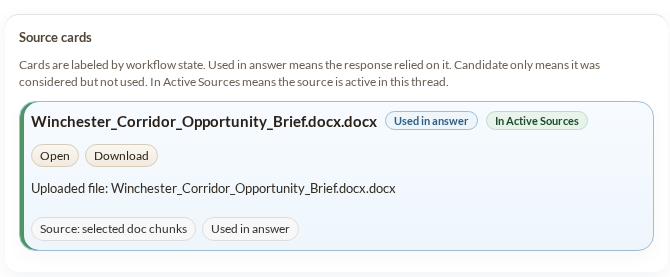
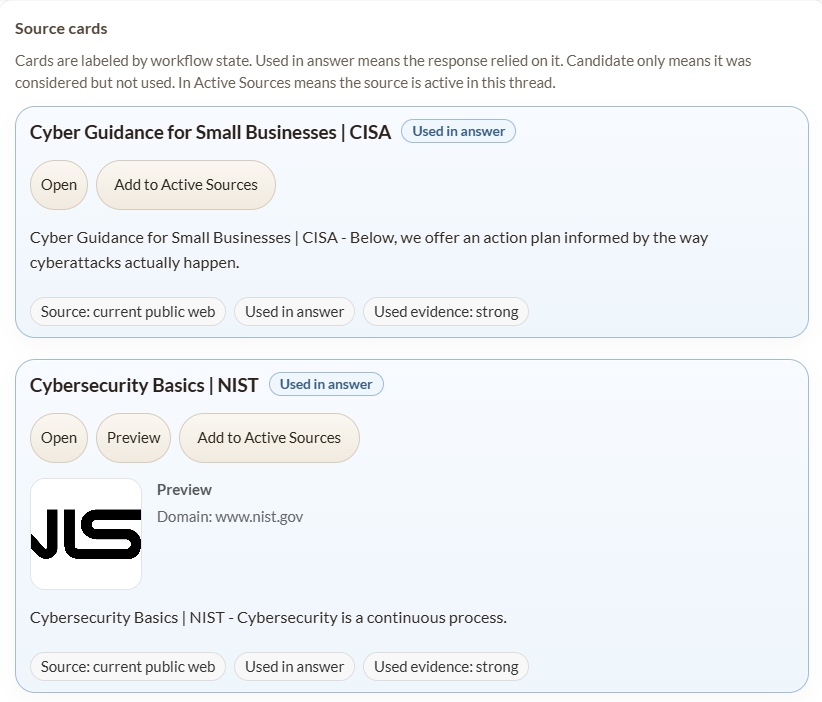
Source cards distinguish information used in an answer from material that is simply available in the thread.

Winchester selected source marked Used in answer and In Active Sources
Winchester opportunity brief. The source is marked Used in answer and In Active Sources.

02 / Documents

Bring documents into the work.

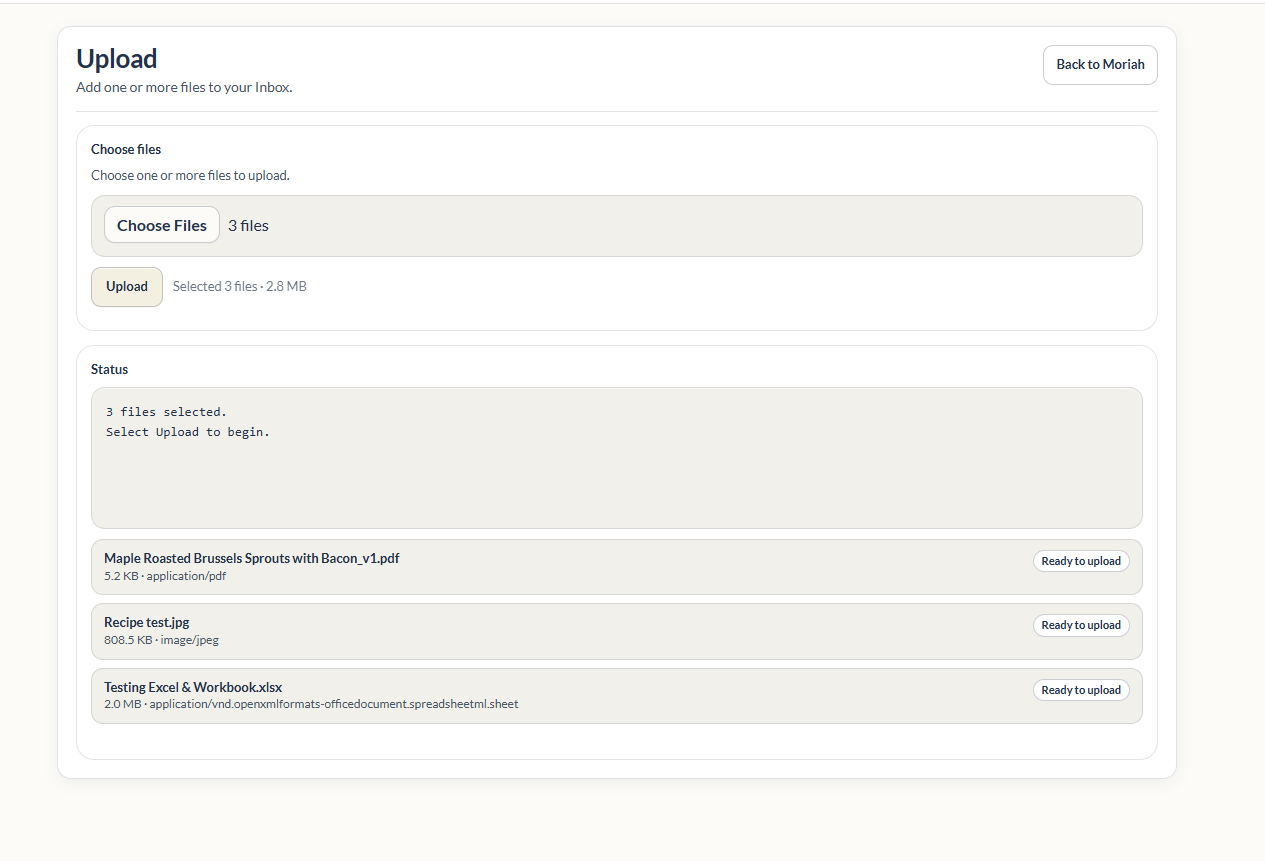
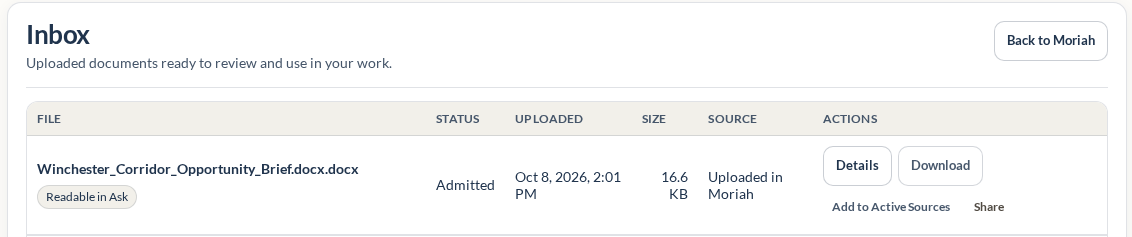
See file selection, a completed upload, and an Inbox item with its own actions—three separate examples of the document workflow.

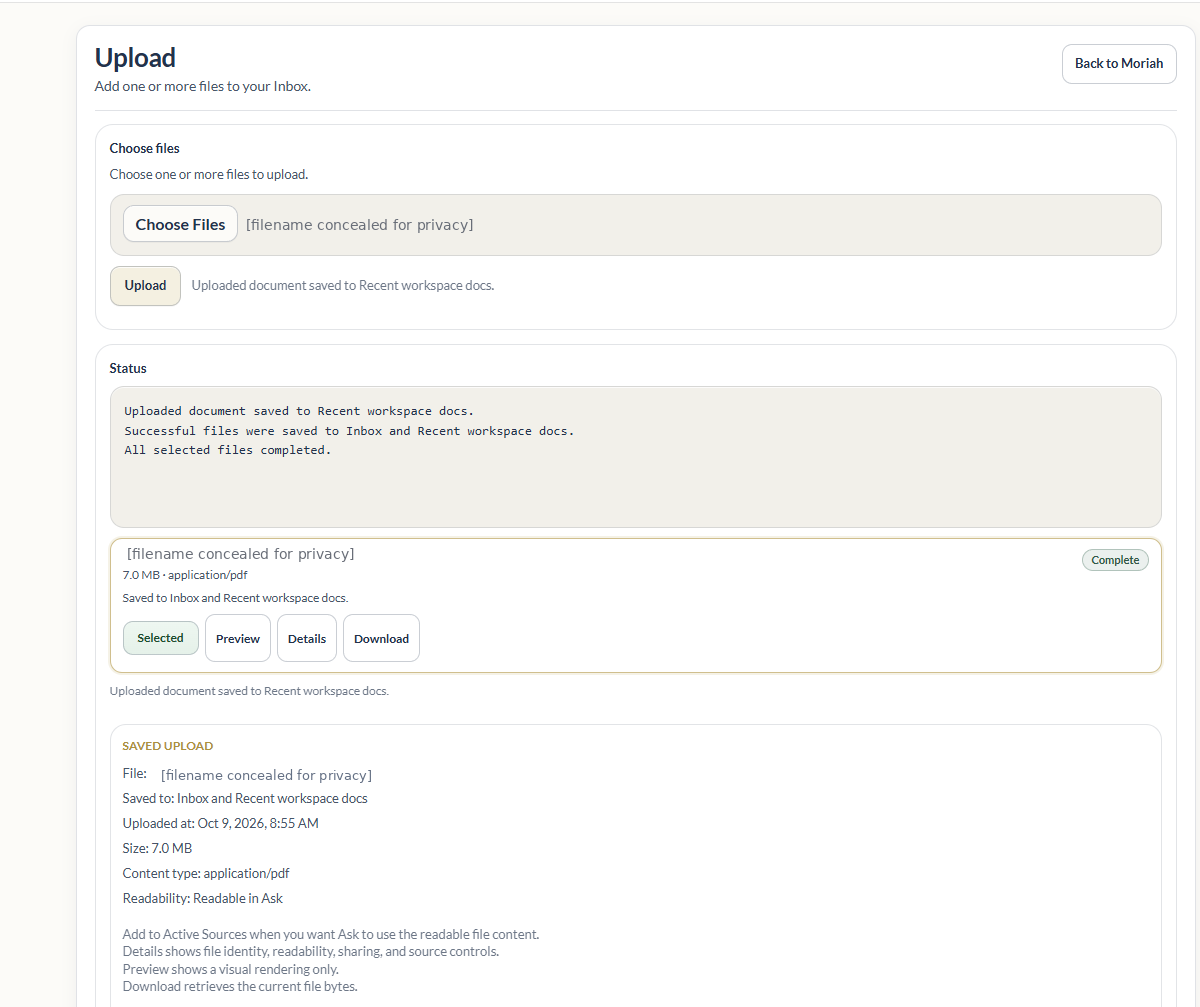
Completed PDF upload
Completed upload. A PDF is shown as admitted to Moriah.

03 / Saved work

Return to where you left off.

Recent Work keeps saved threads within reach, with their work history and linked sources alongside them.

Winchester saved-thread row with Resume action
Resume saved work. The Winchester thread has a Resume option in Recent Work.
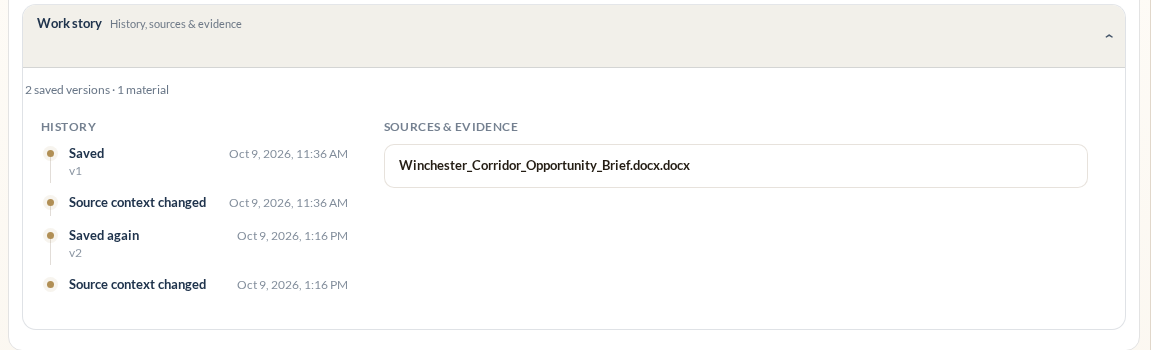
Winchester Work Story history and retained source
Follow the work’s history. Work Story shows two saved revisions and the named Winchester source.

04 / Customize Moriah

Make the environment yours.

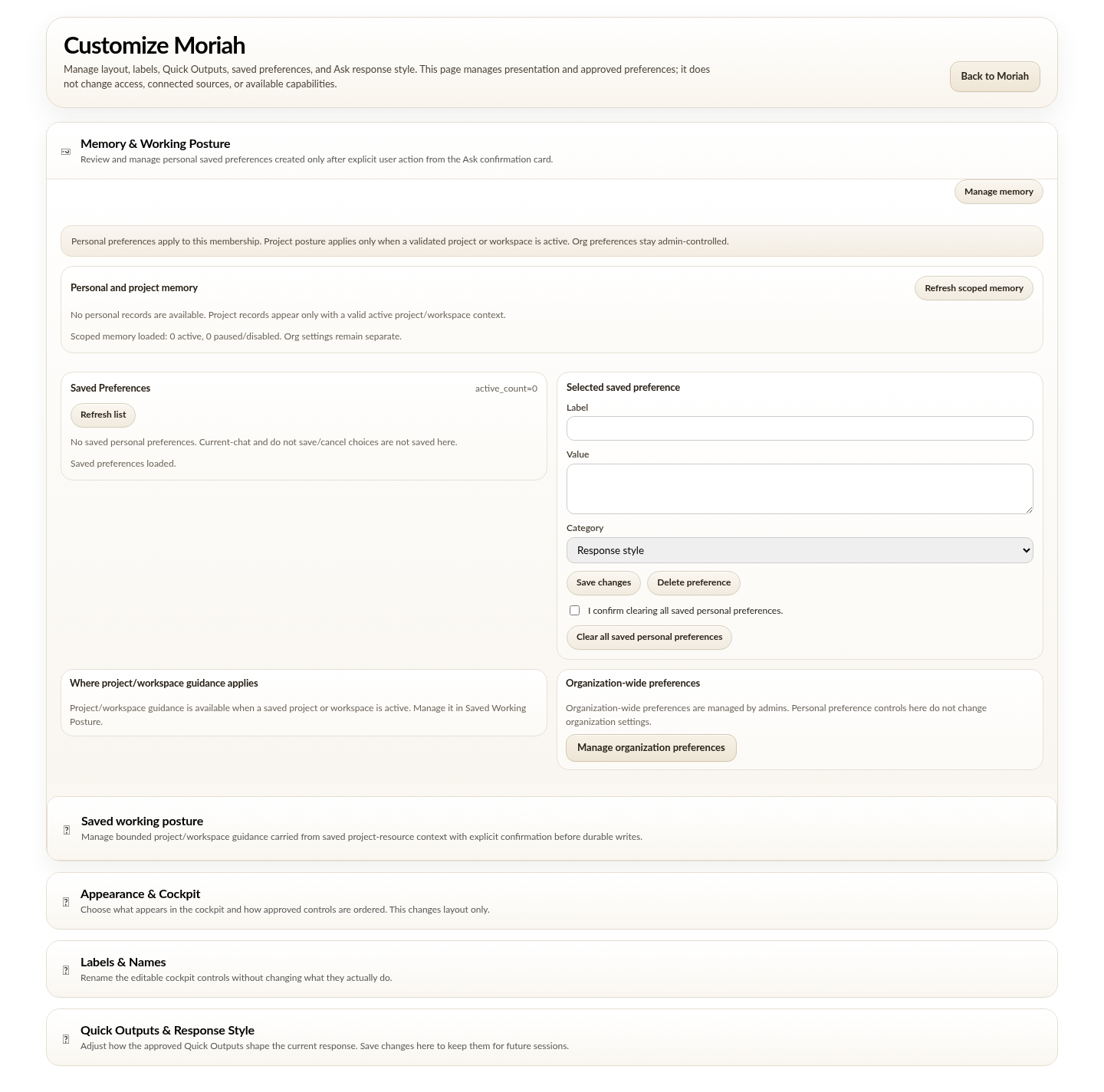
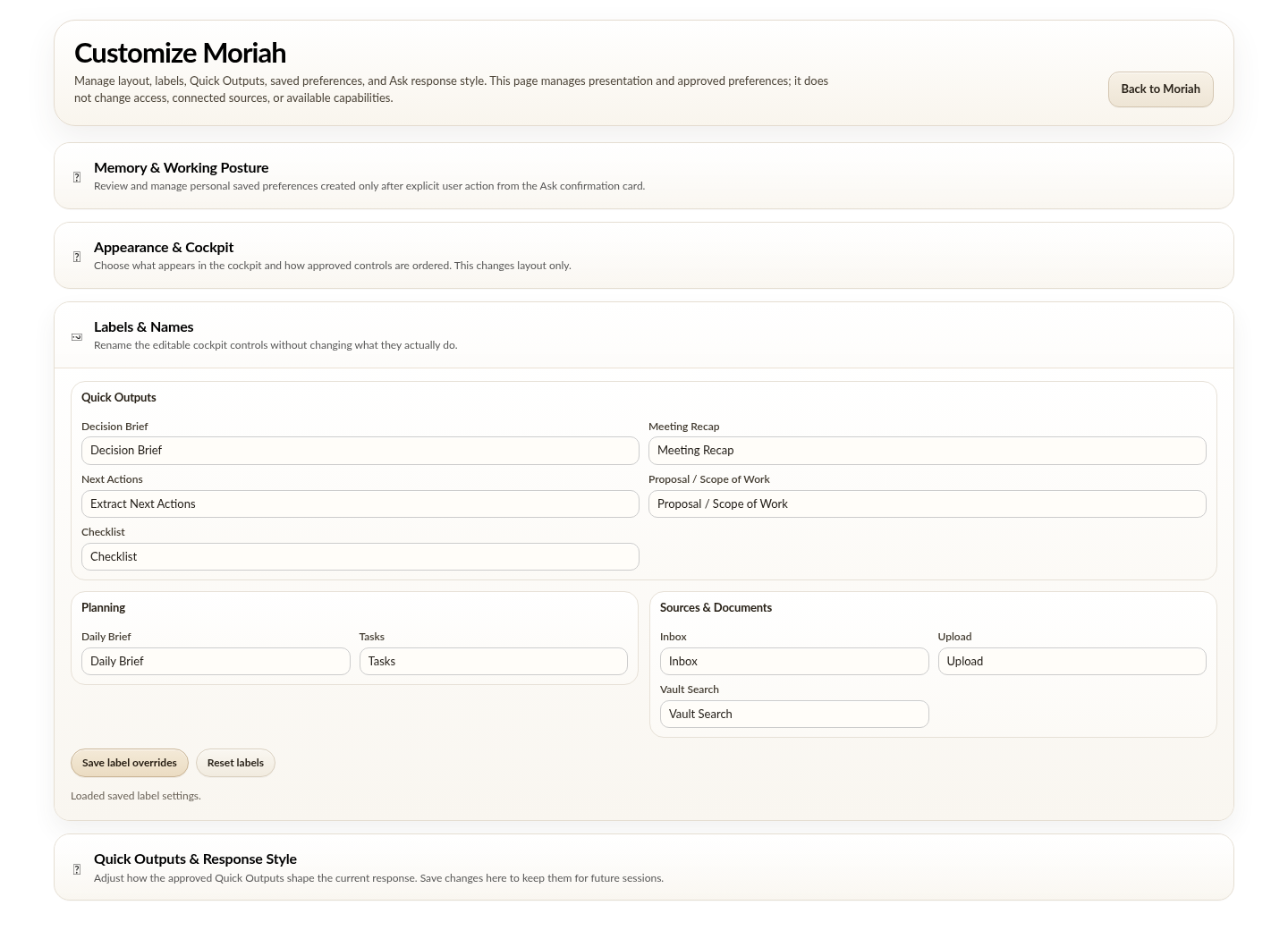
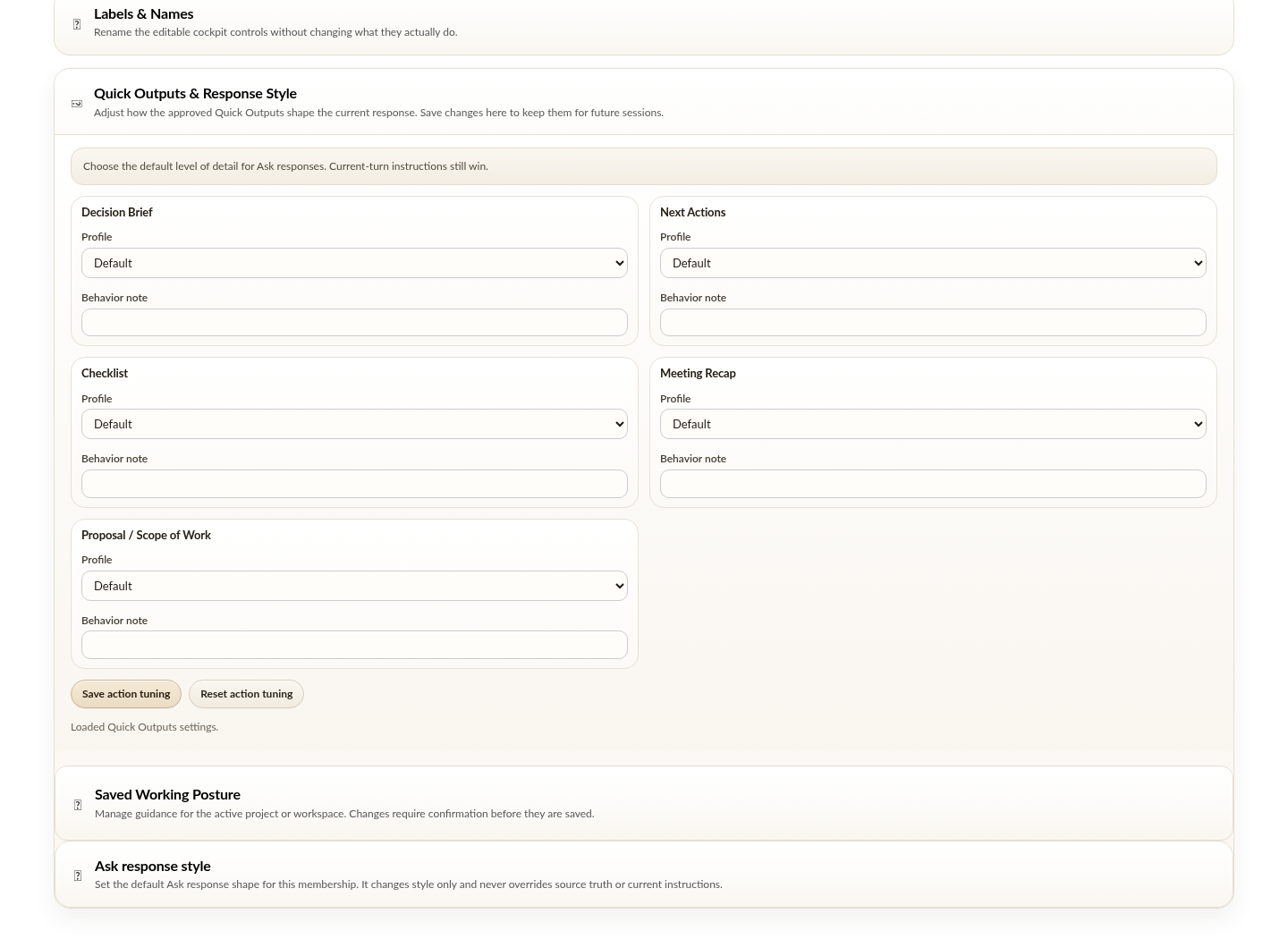
Explore appearance, memory and working preferences, labels, and Quick Output settings.

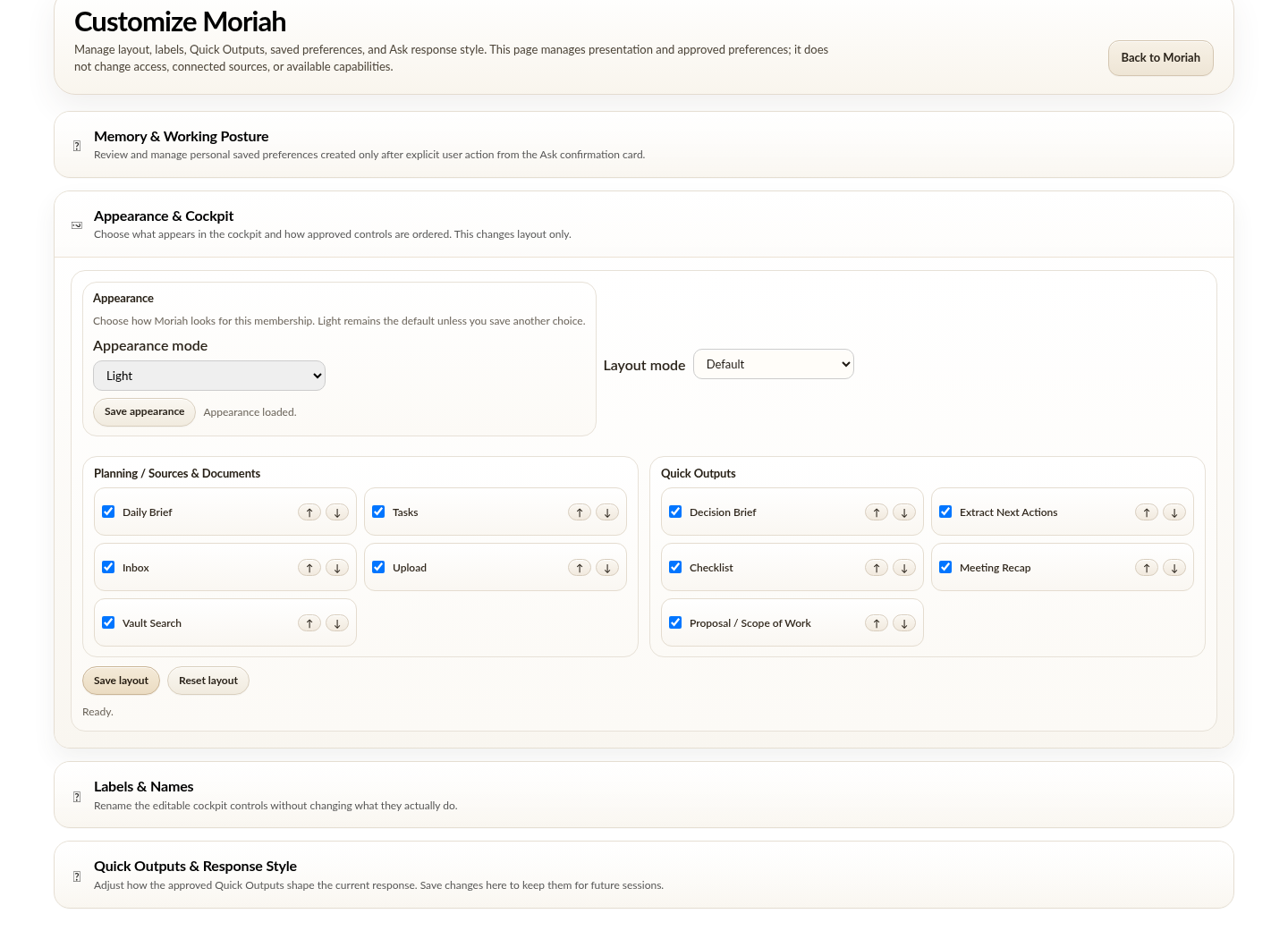
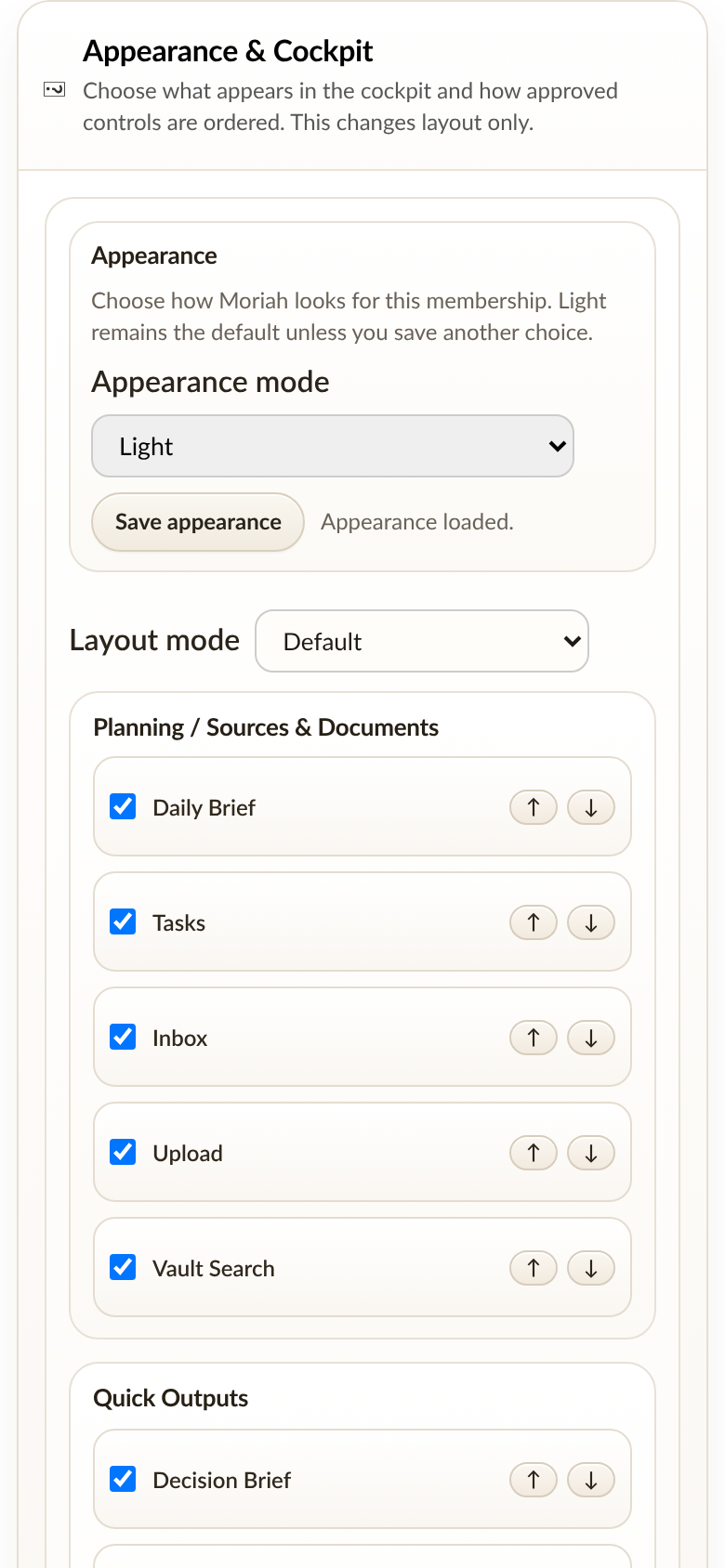
Appearance and cockpit
Appearance and cockpit. Choose the layout and arrange the controls that matter to you.
On smaller screensThe web cockpit adapts.

The same Moriah interface adjusts for a narrower browser window.

Responsive Moriah Customize appearance controls

How it works in practice

A real assistant should do more than answer.

The ideas above are the short version. These eight operating principles explain how they show up in the product. Open any principle when you want the deeper detail.

01Carry the work forwardUseful work should survive the conversation.

Moriah is designed around a simple operating loop: bring in the work, reason across it, produce something useful, save it, reopen it later, and continue without forcing the user to reconstruct the history from scratch.

02Remember deliberatelyA second brain should know what should carry forward — and what should not.

Moriah is built to distinguish immediate working context from project or workspace posture, durable preferences, source material, and information that should remain temporary. Memory should reduce needless re-explanation without becoming an indiscriminate archive or silently overruling current instructions and source truth.

03Work from sourcesEvidence should remain visible enough to challenge.

Moriah can reason from documents, selected sources, saved artifacts, connected systems, and current/public research while preserving the distinction between source-backed facts, model inference, assumptions, unknowns, and the next thing that still needs proof.

04Use the right tool for the workThe user should not have to manage every engine underneath the work.

Search should search. Document systems should parse and produce documents. Specialized providers should do the work they are good at. Premium reasoning should be used where judgment and synthesis justify it. Moriah coordinates those capabilities so the user can stay focused on the job rather than the machinery.

05Adapt around the operatorA useful assistant should learn the working posture without becoming a scripted persona.

Moriah is designed so approved user preferences, project criteria, organization posture, available sources, and configured capabilities can shape the work naturally. The goal is not a pile of canned answers. It is a consistent operating environment that can reason in context.

06Operate within boundariesConnected does not mean unrestricted.

Moriah is built around controlled access. Users, tools, sources, providers, and administrative actions do not all receive the same authority simply because they are available. Private access, role boundaries, revocation, and proof-oriented release discipline are part of the operating design.

07Work with people and organizationsA personal second brain can still live inside a managed environment.

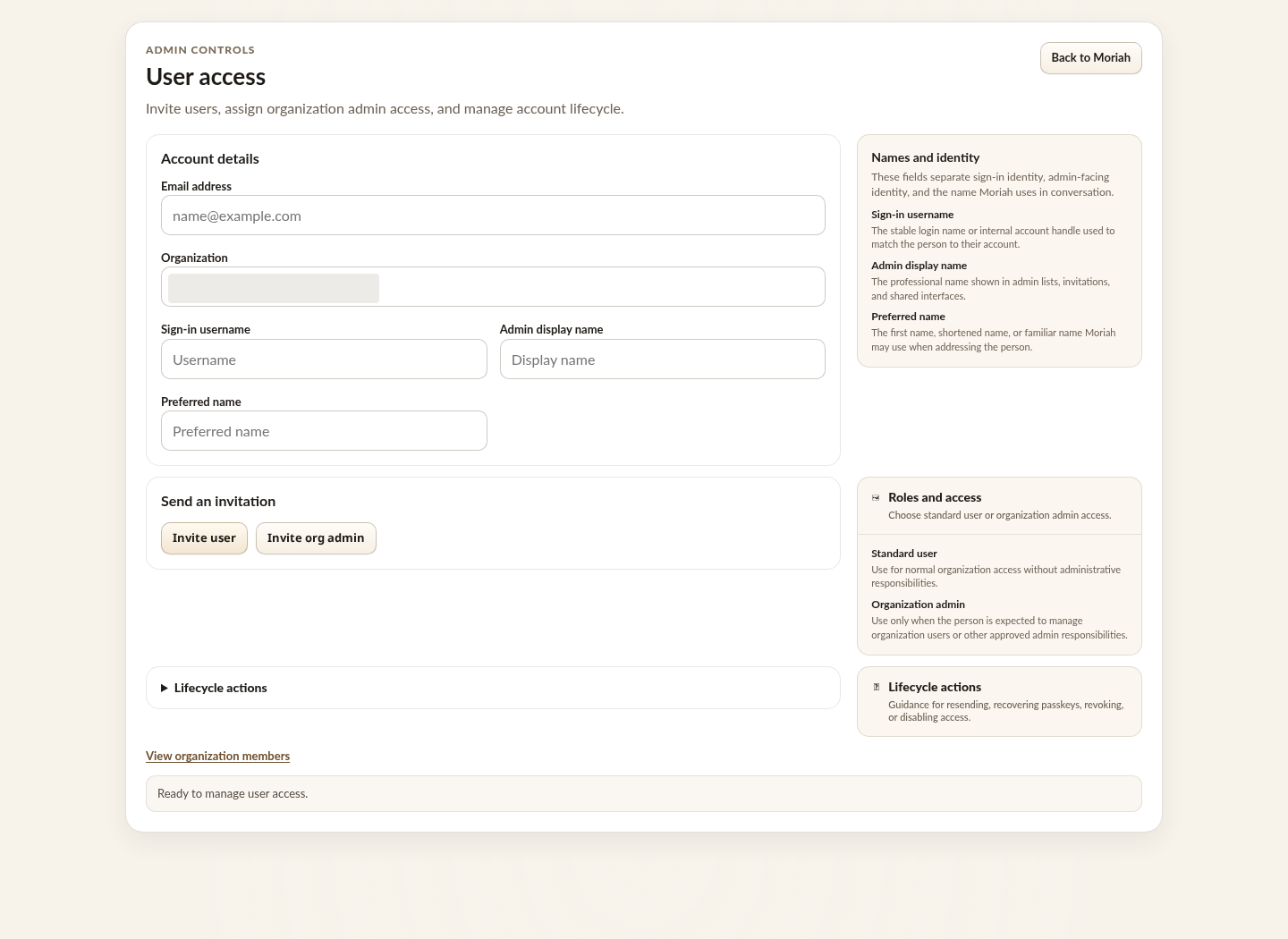
Moriah can support individual working context alongside organization membership, controlled onboarding, access changes, shared and private work boundaries, provider readiness, and administrative configuration. The human account and role remain the authority source for privileged work.

08Support provider choice without provider chaosThe operating environment should not have to belong to one AI vendor.

Moriah is designed around provider and capability slots rather than one mandatory engine. FiveFold can supply platform-managed capability, while approved organization-level provider or license controls can be supported where the relevant capability and governance path are enabled. The user should not have to rebuild the workflow around each provider.

Flexible by design

One foundation. More than one way to put it to work.

Moriah is not built around one fixed user or workflow. The same governed operating foundation is designed to adapt around a person or organization, and selected organization-specific solutions can be evaluated where the technical, licensing, and governance boundaries support them.

01

Moriah around you

An operating assistant can adapt to the person doing the work through approved preferences, memory, project context, recurring criteria, sources, retained work, and useful outputs.

02

Moriah around your organization

The same continuity can operate inside organizational boundaries: users, authority, private and shared context, sources, workflows, provider posture, administration, onboarding, and revocation.

03

Moriah around a solution

For selected cases, FiveFold can evaluate organization-specific implementations, services, or integrations where the technical, licensing, and governance boundaries support them.

Selected solution and integration relationships are evaluated individually rather than presented as a standard white-label or universal redistribution program.

Broader strategic conversations

Beyond adopting Moriah, FiveFold is open to conversations about selected technology integrations, strategic licensing, partnerships, investment, and potential acquisition of defined Moriah software or intellectual-property assets.

Each opportunity would be evaluated individually for technical fit, rights, responsibilities, and commercial terms.

Start a conversation

The system underneath Moriah

One operating environment. Consistent rules around the work.

The cockpit is the visible surface. Underneath it, Moriah keeps source and evidence state, retained work, authority, supported capabilities, organizations, artifacts, and important action boundaries inside one operating environment.

As supported models, tools, sources, and capabilities change, the operating rules around authority, provenance, continuity, readiness, and consequential actions are designed to stay consistent.

That consistent set of operating rules is the trust spine beneath the experience.

Visible layer Moriah cockpit Ask · Threads · Sources · Work · Artifacts
Consistent operating layer Authority · provenance · continuity · capability readiness · action boundaries
Sources & working stateEvidence, documents, retained work, context
Models & capabilitiesReasoning, research, supported providers and tools
Organization & accessUsers, roles, permissions, operating scope

Operating controls

See what runs beneath the cockpit.

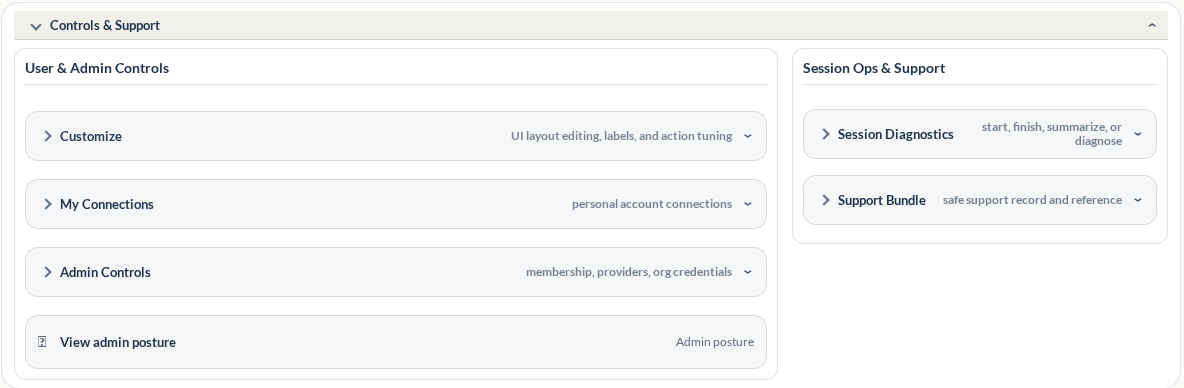
Explore capability readiness, support, and access administration. Availability and setup status remain visible.

Actual Moriah capability readiness summary showing ready setup and reference-only states
Capability readiness. Ready, Needs setup, and Reference only are distinct states—not a promise that every option is connected.

Operating discipline

Built to be operated, not just demonstrated.

Different claims require different proof. A healthy service check is not treated as proof that the entire product works.

FiveFold separates source and change state, the software actually running, live product behavior, and release or recovery evidence so each claim can be checked at the level that matters.

Engineering footprint

Measured October 9, 2026

705,416tracked repository lines
1,821tracked files

The repository spans the product itself, dedicated proof and browser-acceptance systems, operating/support tooling, and the governing documentation used to operate and evolve the system.

Core product / runtime
Proof + browser + operations
Governing documentation

Repository footprint is provided as engineering context, not as a measure of quality, security, maturity, effort, or value.

Current posture

Built carefully. Described honestly.

Moriah is a working software platform under active development and controlled rollout. Capabilities are introduced deliberately rather than represented as universally available. Public claims should follow proven behavior, and product evidence should come from the working system whenever practical.

The goal is not to make Moriah sound bigger than it is. The goal is to make what has actually been built easy to understand.

Back to the front door

See the concise Moriah story.

FiveFoldV.com